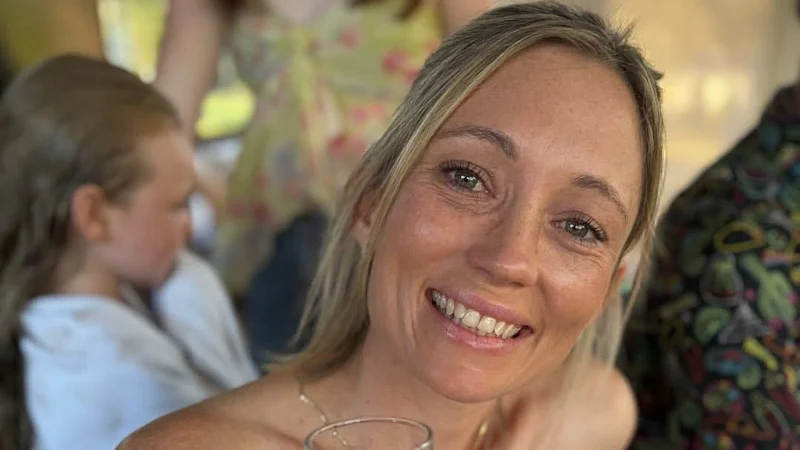


The day of her stroke, Kris Burford remembers feeling exhausted, like she couldn’t wait for the day to end.
The then 30-year-old primary school teacher put her fatigue down to being a working mum with young children, and tried to focus on getting through the last period of the day. But then something weird happened.
“I thought I was writing on the board, but I looked at the board, and I was actually writing down lower,” Burford explains. “I couldn’t get my arm up to write where I wanted to.”
The simple word she was trying to spell for her grade 1 class escaped her, and she asked a student to go get help from the office.
“I couldn’t move the right side of my body or speak,” Burford says. “So the school called an ambulance.”
Burford was rushed to Caboolture Hospital. By the time she arrived, she says her symptoms had subsided, and she was presenting “fairly normal”.
“[They thought] I’d just had a migraine,” she says.
“They were ready to discharge me but during that time, I was on the phone to my husband and I just started speaking absolute nonsense. My whole face felt numb, and my tongue felt like it was really big and swollen.
“They ended up giving me a CT scan and found I had a [blood] clot blocking one whole side of my brain.”
About 50,000 Australians suffer stroke each year, costing the country’s health system an estimated $5 billion.
The two main types of stroke – ischaemic or haemorrhagic – are caused by a disruption of blood flow to the brain and both are time-critical to treat. The sooner blood flow can be restored, the lower the risk of brain damage, permanent disability or death.
Burford’s luck swung both ways the day she suffered a stroke.
By the time she was properly diagnosed and rushed to Brisbane for treatment, she had missed the narrow window for administering clot-busting drugs. But as she was being prepared for surgery, a second CT scan showed the clot had dispersed by itself, with minimal damage to the affected brain region.
“There was a period of time where I was just exhausted, because when your brain’s damaged, the fatigue is insane,” she says.
“But apart from that, I was very, very lucky.”
University of Queensland neuroscientist and PhD candidate Chantelle Jackson says many stroke patients, especially those living in regional and remote communities, are significantly impacted by delayed treatment.
It’s a factor motivating her research project: developing a tool – something as simple as a pair of glasses or listening device – that could help stimulate brain cells and boost blood flow in the critical early window after a stroke.
“You can think of it as a bit of a choir, so after stroke the neurons, the brain cells, they’re not firing properly, it’s chaotic, it’s a tonal mess,” Jackson explains.
“The stimulation helps those neurons fire together in the oscillatory pattern they’re meant to, it helps restore synchrony between neural populations … when the neurons are firing properly, they’re less likely to die.
“So when you have more neurons, you’re going to get more blood flow to those areas.”
Jackson was awarded a Westpac Future Leaders Scholarship to fund her research in February and will work alongside neuroscientist Dr Matilde Balbi in UQ’s Queensland Brain Institute to develop the device over the next three years.
“With stroke, there is less blood that is delivered to a specific brain region, and if blood cannot deliver oxygen and nutrients to that specific brain region, all the brain cells die,” Balbi says.
“With our intervention, when we try to stimulate the brain, we try to rescue this degenerative process.”
Preclinical trials using mice have returned promising results, Balbi says. The next step is to test potential therapies on humans.
“This [is a] non-invasive form of stimulation. So [it could be] visual, like goggles, but also auditory, so headphones,” she explains.
“We don’t need to drill anything in the brain, it really is like as simple as having a screen in front of you and headphones on, that could potentially improve motor function and cognition.”
A hole in her heart was later determined as the cause of Burford’s stroke. While the risk of another stroke is low, she is supportive of any research that could help patients, especially those far from metropolitan health services.
“We’re rural in Mount Kilcoy [in the Somerset Region], and the ambulance did take quite a long time to get there.
“So if people are aware of the signs and symptoms of stroke, and that technology is there, then that could be life-saving for someone.”
Start the day with a summary of the day’s most important and interesting stories, analysis and insights. Sign up for our Morning Edition newsletter.
From our partners